

Exercise for elderly couples works best when you train side by side but keep your own goals. Choose simple moves you can both do at your own level, such as chair stands, band exercises and stepping drills, and practise them together two or three times a week. You get company and encouragement, while each of you progresses at your own pace.
SilverFit is a Singapore-based active ageing company that helps seniors build strength, balance and confidence through its RE Method™. Many of the seniors we coach live with a spouse, and often one partner watches while the other trains.

Is it a good idea for elderly couples to exercise together?
Usually, yes, as long as you don’t expect to do exactly the same workout. Couples tend to influence each other’s activity. In the US-based ARIC study of 3,261 spousal pairs, followed over six years, changes in one spouse’s physical activity were linked to changes in the other’s, and people were more likely to meet activity recommendations when their spouse did.
There is a useful caution from closer to home. A study by NTU Singapore researchers of 240 people in Singapore aged 54 to 72, published in October 2023, found that older adults who exercised with a spouse were less physically active than those who exercised without one. The researchers suggested that encouraging older adults to exercise individually may be more effective.
Put together, the lesson is simple: your partner can be your best motivator, but each of you still needs your own plan.
What one couple taught us about training together
Recently we started coaching a couple in their late seventies at home. He lives with a painful joint condition, and some days just getting up from a chair takes effort. She is fitter, but her shoulders and neck have been stiff for years, and she carried the quiet worry of watching him struggle.
So we trained them together. Each had their own exercises and their own level, done in the same room at the same time. She cheered him on as he pushed through his exercises, and she worked her shoulders with a resistance band right beside him. He stopped feeling like a burden. She stopped watching from the sidelines. They became teammates.
Exercise for elderly couples: 4 simple moves to do side by side
Do these two or three times a week. Start gently and let each person choose their own number of repetitions.
- Side-by-side sit-to-stands (5–10 each). Sit on two sturdy chairs placed against a wall. Stand up, pause, then sit down slowly. Use your hands on your thighs if you need to. Stop if you feel pain or dizziness.
- Mirror band rows (8–12 each). Sit facing each other, each holding your own light resistance band looped around your feet. Pull your elbows back, squeeze your shoulder blades, then release slowly. Keep the movement smooth, and stop if your shoulder or neck hurts.
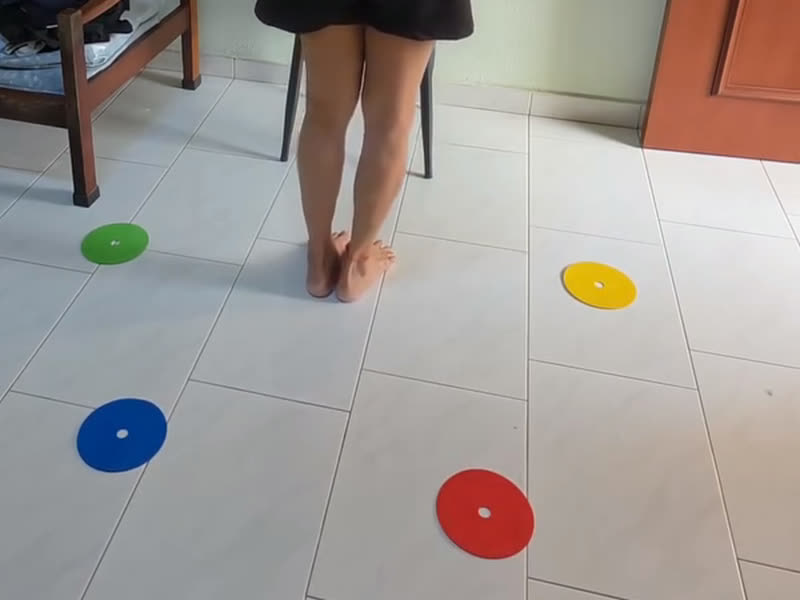
- Coloured-marker stepping (1–2 minutes each). Place four coloured markers or pieces of tape on the floor around you. Your partner calls out a colour and a foot (“left foot, blue!”); you step to it and back. Keep a chair or wall within reach, wear grippy footwear or go barefoot on a dry floor, and take turns calling.
- A daily walk together (10–20 minutes). Walk at a pace where you can still talk, perhaps around the void deck or along a park connector. If one of you is faster, the faster partner can add a loop while the other rests on a bench.
For more ideas, read How to Motivate Elderly Parents to Exercise and How Many Steps a Day for Seniors?
How can couples keep each other going without nagging?
- Set separate goals, share the schedule. Agree on when you train, but let each person decide how much.
- Cheer, don’t coach. “Good one!” lands better than “Do it properly.”
- Celebrate small wins. One more chair stand, one less hand on the railing: notice them out loud.
- Plan for off days. If one partner is tired, the other can still do a short session.
How SilverFit approaches this
At SilverFit, our purpose is to help seniors age with strength, confidence and purpose: Strong at Every Age. Healthy ageing is about more than living longer. It is about living stronger, moving confidently and continuing to enjoy the people who matter most, and for many seniors that starts with the person beside them. Training as a couple draws on all four pillars of the RE Method™:
- RE·STORE (Quality of Life) is where we go deepest here: independence, relationships and the freedom to keep doing things together, from wet market trips to visiting the grandchildren.
- RE·BUILD (Strength) gives each partner the leg and arm strength for daily life, scaled to each person.
- RE·BALANCE (Movement) trains balance and coordination, such as the stepping drill above.
- RE·NEW (Mindset) builds confidence, with partners celebrating each other’s small wins.
In the SilverFit RE Programme™, we start with an assessment for each person, then coach the 8-Week RE Programme™ one-to-one, in small groups or at home, which suits couples well, followed by ongoing support. Active Ageing Centres, community clubs and condominiums can also bring this kind of shared training to their residents through our Active Ageing Solutions. More guides are on our blog.
Frequently asked questions
Can elderly couples with different fitness levels exercise together?
Yes. Do the same type of exercise but adjust the amount: one partner may do 10 chair stands while the other does 5 with hands on the thighs. The point is to train at the same time, not to keep up with each other.
What is the best exercise for elderly couples to do at home?
Sit-to-stands, resistance band rows and simple stepping drills need little space and very little equipment. Add a daily walk together.
My parents never exercise. Should they start together?
Starting together can make the first sessions less daunting, especially if one parent is more hesitant. Give each of them their own small goal, and check with their doctor first if either has a heart, joint or balance condition.
How often should senior couples exercise together?
Two or three short sessions a week of strength and balance work is a good start, with walks in between. Consistency matters more than intensity.
A note on safety: exercise on a dry, uncluttered floor with a sturdy chair or wall within reach, and wear well-fitting shoes or go barefoot on a non-slip surface. Each partner should go at their own pace; stop if you feel pain, dizziness, chest discomfort or unusual breathlessness. If either of you has a heart, joint or balance condition, or recent surgery, check with your doctor before starting new exercises. This article is general information, not personalised advice.
Ready to get stronger together?
Book a Coaching Call, explore the SilverFit RE Programme™, or WhatsApp us at +65 8996 5751.